Countertop Gelato Display Case for a Small Shop
Countertop gelato display cases compared by manufacturer spec: per-model temperature range, NSF/ETL status, and when to call a dealer instead.
By FranchiseFeast EditorialAI-assisted, source-checkedPublished July 16, 2026Updated October 15, 2026
Disclosure: As an Amazon Associate I earn from qualifying purchases. Some links below are Amazon affiliate links; buying through them costs you nothing extra. It never changes which products we recommend, and prices always come from Amazon, not from us. Details in ourfull disclosure.
A countertop gelato display case is a compact freezer for displaying and serving gelato or ice cream. Compare the exact model’s published temperature range, pan fit and electrical requirements with your menu and counter space before buying.
Pick by the case’s published temperature range, not its name: Amazon lists the Koolmore KM-CGD-5P (5 pans, ETL per Koolmore) and Cooler Depot DW6R (6 pans, 115V per its maker sheet) in stock as of October 2026. The KM-CGD-6P (-8F to 0F, built-in sneeze guard per Koolmore) is sold through Koolmore’s site while its Amazon listing is unavailable as of October 2026; the NEMOX is the smallest-footprint option here, but confirm it is the documented 120V version. A shop built around gelato should call a dealer for a dipping cabinet.
Who this case is for, and who should skip it
This gear fits a cafe adding gelato or ice cream as a secondary line with limited counter space. If gelato is the product you’re building the shop around, or persistent fogging is interfering with the display, discuss capacity and glass options with a dealer before choosing a countertop unit.
Do gelato and ice cream actually need different temperatures?
Carpigiani UK puts Italian gelato service at -14C, about 7F, generally warmer than ice cream. Dream Scoops gives gelato a range of 10F to 22F. KaTom Learning Center says gelato is stored between 7F and 12F, 10 to 15 degrees warmer than ice cream, and explains forced-air refrigeration for gelato mounded above pan rims, versus cold-wall refrigeration around tubs. Check each case’s own cooling type.
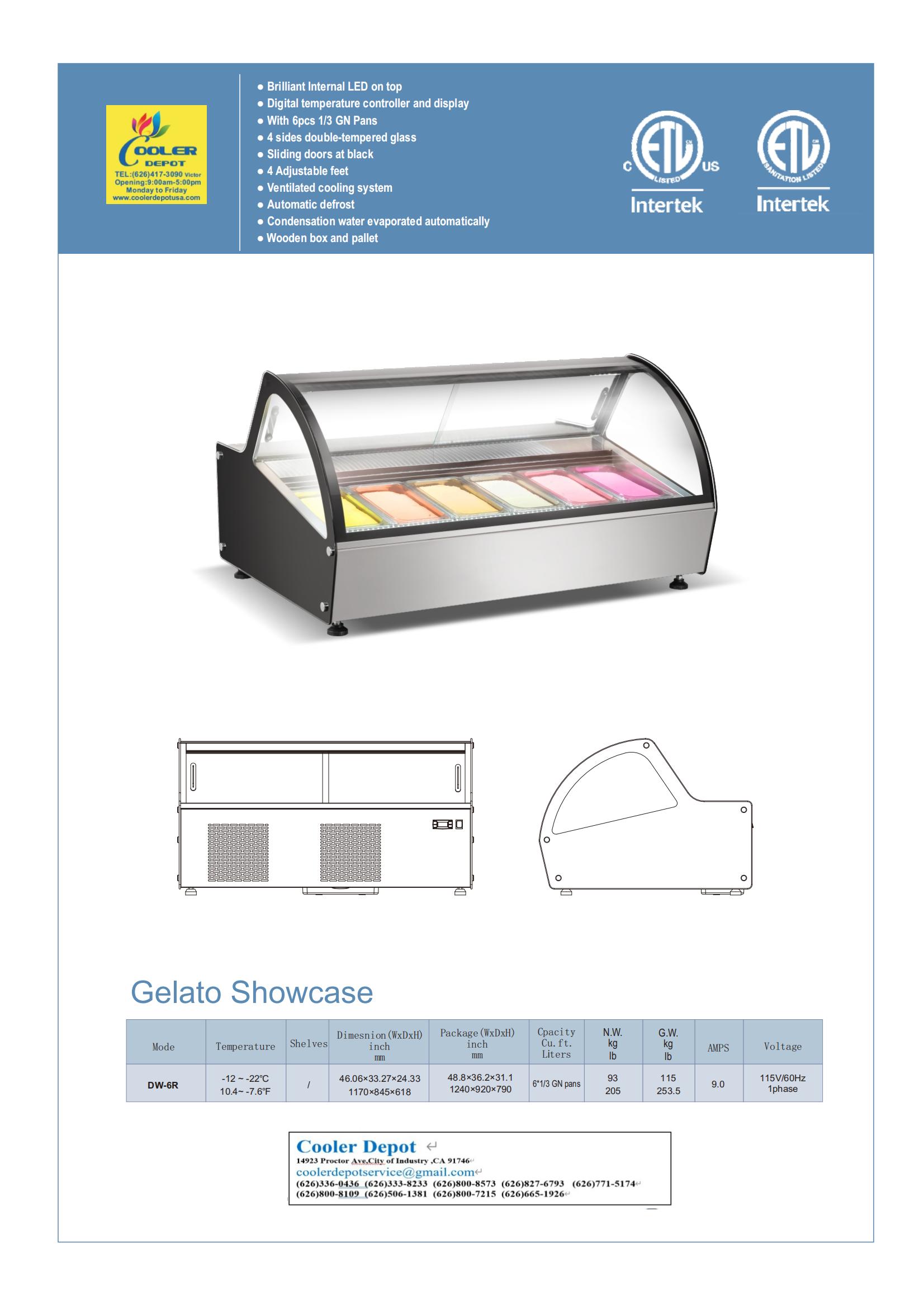
Compare that guidance with the hardware: Koolmore publishes -8F to 0F for the KM-CGD-6P, but 7.6F to 10.4F in the KM-CGD-5P description and -7.6F to 10.4F in its specification table. Cooler Depot’s DW6R sheet gives 10.4F to -7.6F (-12C to -22C), while NEMOX publishes -10C to -16C (14F to 3.2F). Match the published range to your product’s serving needs.
Check each model’s temperature range
Here’s what each manufacturer publishes:
| Model | Marketed as | Pans | Width | Published temperature range (per maker) | Voltage (US) | Certification (per maker) | Heated anti-condensation glass | Where to buy |
|---|---|---|---|---|---|---|---|---|
| NEMOX 4-Magic Pro 100 | Gelato display case | 4 x GN 1/4, 2.5L each, 100mm deep | 1000mm (about 39.4in) | -10C to -16C (14F to 3.2F) | 120V version in download index; main page lists 220-240V | Not stated by maker | Not stated by maker | NEMOX; confirm 120V supply |
| Koolmore KM-CGD-6P | Gelato display case | 6 x 1/3 GN | 45.24in | -8F to 0F | 110V | ETL Listed for Safety and Sanitation | No heating strips, per Koolmore | Koolmore; Amazon unavailable as of October 2026 |
| Koolmore KM-CGD-8HP | Ice cream display case | 4 x 1/3 GN | 31.69in | -8F to 0F | 110V | ETL Listed for Safety and Sanitation | No heating strips, per Koolmore | Koolmore |
| Koolmore KM-CGD-5P | Ice cream display freezer | 5 x 1/2 GN in description; 5 x 5L, 14.17 x 6.5 x 4.72in in spec table | 38.5in | Description: 7.6F to 10.4F; spec table: -7.6F to 10.4F | 120V | ETL Listed for Safety and Sanitation | No heating strips, per Koolmore | Amazon card below |
| Cooler Depot DW6R | Gelato case / dipping freezer | 6 x 1/3 GN | 46.06in | -12C to -22C (10.4F to -7.6F) | 115V/60Hz, 9.0A | ETL/Intertek marks on maker sheet; specific standards not stated | Not stated by maker | Amazon card below |
The gelato-named 6P publishes -8F to 0F; the ice-cream-named 5P publishes a range reaching 10.4F, with Koolmore listing its low end as both 7.6F and -7.6F. Confirm that discrepancy with Koolmore before choosing by temperature.
For a non-affiliate option, Koolmore’s KM-CGD-6P page lists a built-in glass sneeze guard and six 1/3 GN pans. Its Amazon listing is currently unavailable as of October 2026. NEMOX’s maker page lists 1000 x 450 x 380mm exterior dimensions, while its shop lists 100 x 45 x 36cm; confirm the height for your counter. Its download index lists a “4 MAGIC PRO 100 I-GREEN 120V” version, so confirm voltage and availability with the seller.
The picks below are affiliate links to Amazon; we may earn a commission at no extra cost to you. FranchiseFeast is a participant in the Amazon Associates Program. As an Amazon Associate I earn from qualifying purchases. Prices are shown live on Amazon, never by us.
5-pan, sold as ice cream, published range reaches 10.4F
Koolmore KM-CGD-5P, 39in 5-Pan Ice Cream Display Freezer
- Dimensions / voltage
- 38.5 x 25.6 x 11.8in exterior; 120V, per Koolmore
- Pans, per Koolmore
- Description: five 1/2 GN pans; spec table: five 5-liter pans, 14.17 x 6.5 x 4.72in
- Temperature, per Koolmore
- Description: 7.6F to 10.4F; spec table: -7.6F to 10.4F
- Certification, per Koolmore
- ETL Listed for Safety and Sanitation
- Anti-condensation glass heating strips
- No, per Koolmore
- Amazon availability
- Sold by Amazon.com; in stock as of October 2026
The published range reaches 10.4F, but confirm the conflicting low-end temperature and pan specifications with Koolmore before ordering. Koolmore describes a flat glass top and names no sneeze guard; ask your health department what protection your setup needs.
Specs: Koolmore KM-CGD-5P product page and Amazon listing
6-pan budget tier; 'NSF Certified' is in the listing title
Cooler Depot DW6R, 6-Pan Gelato Freezer Display Case
- Pans / dimensions
- 6 x 1/3 GN; 46.06 x 33.27 x 24.33in, per Cooler Depot's sheet
- Temperature
- -12C to -22C (10.4F to -7.6F), per Cooler Depot's sheet
- Electrical
- 115V/60Hz, 9.0A, per Cooler Depot's sheet
- Certification marks
- ETL/Intertek marks on Cooler Depot's sheet
- Amazon availability
- Sold by Cooler Depot USA; in stock as of October 2026
NSF's public listings include Honey Management Group Inc dba Cooler Depot for NSF/ANSI 2 food equipment such as sinks and tables, but showed no DW6R model as of October 15, 2026. That does not prove the model is uncertified. Amazon's description gives different dimensions and 680W, while the maker sheet does not state wattage; confirm the specification and model certification with the seller.
Specs: Cooler Depot DW-6R product page and spec sheet; NSF public listings; Amazon listing
Check the Cooler Depot maker sheet and NSF public listings for the exact model before ordering.
Pan sizes: match the GN fraction, not just the liter count
UK supplier HTG Extras lists a standard 5-liter Napoli gelato pan at 360 x 165 x 120mm. That is not automatically the size supplied with your case. Koolmore lists 1/3 GN pans for the 6P and 8HP; its 5P description says five 1/2 GN pans, while its spec table says five 5-liter pans at 14.17 x 6.5 x 4.72in. NEMOX’s shop lists four GN 1/4 pans, 100mm deep and 2.5L each. Match the GN fraction and check actual dimensions, depth and rail fit before ordering replacements; capacity alone does not establish compatibility.
Pans and spades
GN third-size replacement candidate; confirm case fit
Vollrath Super Pan 3 90342, Third-Size 4in Pan
- Size, per Vollrath
- Third size, 176 x 325mm; 4in (100mm) deep
- Material, per Vollrath
- 22-gauge 300-series stainless steel
- Standard, per Vollrath
- EN 631-1 compliant Gastronorm
- Amazon availability
- Sold by Hubert Company; low stock as of October 2026
Koolmore lists the 6P's included 1/3 GN pans at 12.8 x 6.3 x 3.9in, close to but not identical with Vollrath's nominal dimensions. Check fit in your case before buying a set.
Specs: Vollrath 90342 product page and catalog; Koolmore KM-CGD-6P product page; Amazon listing
Ice cream spade, as named by Winco
Winco ICS-1 Ice Cream Spade
- Use, per Winco
- Efficiently scrape, scoop, lift and release frozen treats.
- Amazon seller
- Amazon.com, as of October 2026; confirm current availability
Winco calls the ICS-1 an ice cream spade; the Amazon listing identifies the same model under Ice Cream Spreader. Choose it for that stated use rather than assuming it is a specifically Italian-style gelato spatola.
Specs: Winco ICS-1 product page and Amazon listing
Plan the scoop station alongside the case with the dipper well guide.
What the food code actually requires, and what it doesn’t
The FDA Food Code 2022, section 3-501.16(A)(2), sets cold holding for time/temperature-control-for-safety food at 41F or less, subject to the section’s exceptions. That is not gelato serving-texture guidance; section 3-501.11 separately addresses frozen storage. Composition standards for what can legally be labeled ice cream fall under 21 CFR 135.110, separate from equipment specifications.
Food Code section 3-306.11 requires displayed food to be protected from contamination by packaging or “counter, service line, or salad bar FOOD guards; display cases; or other effective means.” A built-in guard does not automatically establish compliance for your setup. Confirm what your health department accepts.
Licensing varies by jurisdiction and activity. California CDFA distinguishes the Semi-frozen (Soft-Serve) Milk Products Plant License from the Frozen Milk Products Plant License and the Limited Frozen Manufacturing Permit. The soft-serve license covers direct semi-frozen service using licensed ready-to-use mixes, not hard-frozen processing or packaging. The limited permit allows specified on-premises manufacture and packaging, including hard-frozen products, with a production limit and restrictions on off-premises sales; packaged product does not automatically require the unrestricted plant license.
NYC 311 says you need a Permit to Manufacture Frozen Desserts “to use a frozen dessert machine.” Texas DSHS licenses frozen dessert manufacturers, while Health and Safety Code 440.004 exempts a frozen desserts retail establishment from that license. Local rules can add a frozen dessert permit: the Wichita Falls ordinance linked in the sources requires one in addition to its food establishment permit. Verify the requirements for your activity with the relevant licensing agency and local health department.
Matching the case to your shop
Start with your expected demand and climate, not the product name on the listing. Compare the manufacturer’s published temperature range with what you plan to serve. Confirm certification per model, and discuss a dealer-tier case if capacity or persistent fogging is a concern. Use the coffee shop electrical outlet plan for electrical planning and the countertop bakery display case guide for the cold-case sibling on your counter.
If you’re building out the rest of the counter, see the cafe equipment hub and the coffee shop equipment list. Pair a display case with a proper countertop soft-serve machine if you’re weighing soft-serve against scooped product, and check our soft-serve vs. batch freezer breakdown. An ice cream dipper well keeps a scoop clean between servings, and if dessert is part of a bigger franchise decision, our ice cream and dessert franchise guide covers that side of the math.
Common questions
Can I use the same case for both gelato and ice cream?
Check whether the specific model's published temperature range suits both products. Carpigiani UK describes gelato as served warmer than ice cream. KaTom explains that forced-air gelato cases cool product mounded above pan rims, versus cold-wall refrigeration around tubs. Confirm the exact model's refrigeration type and range rather than relying on its name.
Does a countertop gelato case need a dedicated electrical circuit?
It depends on the nameplate amps, the manual and local electrical code. Koolmore lists the KM-CGD-6P at 110V with a NEMA 5-15P plug; Cooler Depot's DW6R sheet lists 115V and 9.0A. NEMOX's main page lists 220-240V, while its download index documents a 120V version. Confirm the version and electrical requirements before ordering.
Is a sneeze guard required, or is it just a nice-to-have?
FDA Food Code 3-306.11 requires displayed food to be protected from contamination by packaging, counter/service line/salad bar food guards, display cases, or other effective means. A built-in guard does not automatically establish compliance. Confirm what your local health department accepts for your display and service setup.
Why does the display glass keep fogging, and do I need heated glass?
Fogging happens when warm humid air meets cold glass. Koolmore lists no anti-condensation glass heating strips for the KM-CGD-6P, KM-CGD-8HP and KM-CGD-5P; that does not rule out every other condensation-control feature. If fogging persists, discuss your shop conditions with the maker or a dealer. Oscartek lists pyrolytic heat on the Ventura's front and side glass; confirm the configuration before ordering.
Sources
Every figure above traces to one of these sources (page last updated October 15, 2026). Franchise numbers change with each FDD filing year; verify against the current FDD.
- FDA Food Code (official landing page, cold-holding and food-display framework)
- FDA Food Code, 2022 edition
- eCFR, 21 CFR 135.110 (federal standard of identity for ice cream and frozen custard)
- California Dept. of Food and Agriculture, Milk and Dairy Food Safety (frozen dessert plant license tiers)
- NEMOX International, 4 Magic Pro100 manufacturer spec page
- Koolmore, KM-CGD-6P manufacturer spec page (temperature range, ETL listing, construction)
- Koolmore, KM-CGD-5P specifications
- Koolmore, KM-CGD-8HP specifications
- Cooler Depot, DW-6R product page
- Cooler Depot, DW-6R specification sheet
- NSF, public food equipment listings
- NEMOX, 4-Magic Pro100 shop pan specifications
- NEMOX, downloads including 120V version
- Carpigiani UK, The Art and Science of Gelato
- KaTom Learning Center, frozen treat display cases
- Dream Scoops, gelato serving temperatures
- HTG Extras, standard 5-liter Napoli pan
- Vollrath, Super Pan 3 90342
- Vollrath, smallwares catalog with GN dimensions
- Winco, ICS-1 Ice Cream Spade
- Oscartek, Ventura features
- Oscartek, company and standards statement
- Oscartek, Ventura manual including G2106 Dual Temp
- FDA Food Code 2022 PDF, sections 3-306.11 and 3-501.16
- NYC 311, Frozen Dessert Manufacturer Permit
- Texas DSHS, milk and dairy licensing requirements
- Texas Health and Safety Code, section 440.004
- Wichita Falls, frozen dessert permit ordinance hosted by DSHS
Get the Coffee Shop Opening Checklist
A free, phased checklist covering concept and business planning, financing, lease, permits, buildout, hiring, and the final 90-day launch sprint. No spam, unsubscribe anytime.
The kit is educational only, not legal or financial advice. By subscribing you agree to ourterms and privacy policy. How we're paid, including referral fees:affiliate & referral disclosure.
Keep reading
Under $100K
Ice Cream and Dessert Franchise Costs (2026): 7 Brands + Seasonality
Compare seven dessert franchise costs using five 2026 FDDs and two franchise sites, with format-specific investments, fees, outlet counts, and seasonality.
Equipment
Coffee Shop Equipment List With Prices (2026 Budget Guide)
Coffee shop equipment list with 2026 price ranges for espresso, grinders, refrigeration, ice, POS and furniture, from Bellwether Coffee, 7shifts and Naixer.
Equipment
Countertop Soft Serve Machine for Small Business
Countertop soft serve machines compared by per-SKU NSF vs ETL certification, state machine-licensing rules, and real amp-draw math, not just output.
Equipment
Soft Serve Machine vs. Batch Freezer: Which Fits Your Shop
Soft serve dispenses purchased mix instantly; a batch freezer makes scratch recipes but needs a display case. Specs, certification gaps, and the real deciding factor
Equipment
Ice Cream Dipper Well: Code Rules, Picks + Heated Option
What the FDA Food Code, California, and NYC actually require for an ice cream dipper well, plus honest picks and a heated no-plumbing alternative.
Equipment
OSHA First Aid Kit for a Small Cafe: What the Standard Needs
OSHA references the ANSI Z308.1 standard for first aid kits rather than a fixed list. Here is the Class A vs B call, minimum quantities, and burn care for a cafe.
Equipment
Precision Portafilter Basket Upgrade for a Cafe
Precision portafilter baskets for a cafe: VST, IMS, Normcore, MHW-3BOMBER, Creamore, and Rattleware on dose sizing, ridged vs ridgeless, and material specs.